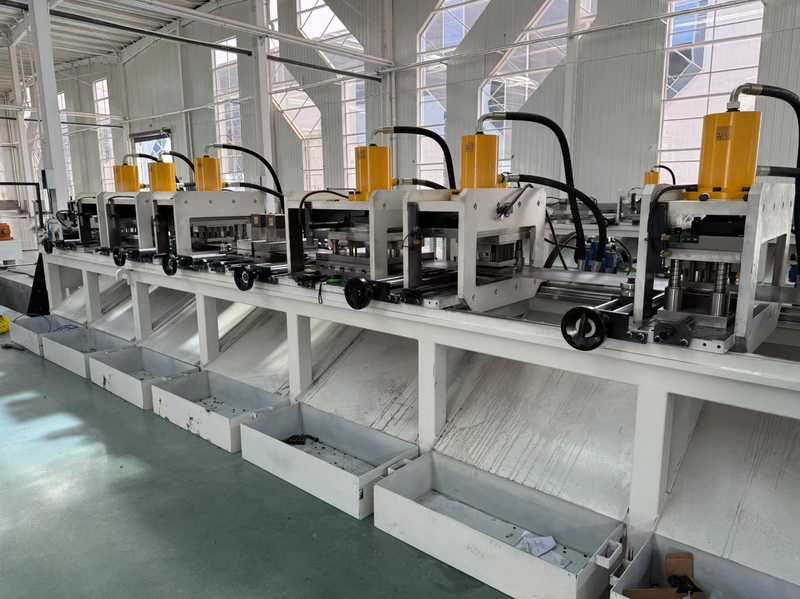
Z-shaped Purlin Roll Forming Machine
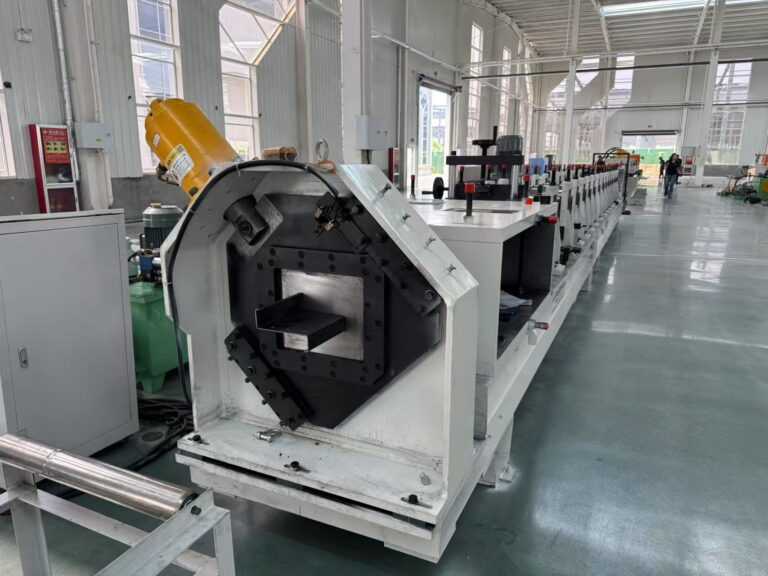
Here is the working video of this machine for everyone to watch:
Product Attributes :
|
1.Formed Material
|
PPGI,GI,AI
|
Thickness:1.5-3mm
|
||
|
2.Decoiler
|
Hydraulic automatic decoiler
|
Manual decoiler(will give you as free)
|
||
|
3.Main body
|
Roller station
|
12 rows(As your requirement)
|
||
|
Diameter of shaft
|
80mm solid shaft
|
|||
|
Material of rollers
|
Gcr 15 with quenched teeatment
|
|||
|
Machine body frame
|
Metal steel welded
|
|||
|
Drive
|
Chain transmission
|
|||
|
Dimension(L*W*H)
|
9500*800*1200(customize)
|
|||
|
Weight
|
About 7T
|
|||
|
4.Cutter
|
Automatic
|
cr12mov material, no scratches, no deformation
|
||
|
5.Voltage
|
380V 50Hz 3Phase
|
As your requirement
|
||
|
6.Control system
|
Electric Box
|
Customized(famous brand)
|
||
|
Language
|
English(Support multiple languages)
|
|||
|
PLC
|
Automatic production of the whole machine. Can set batch, length, quantity, etc.
|
|||
|
7.Forming Speed
|
60-70m/min(customized)
|
The speed depends on the shape of the tile and the thickness of the material.
|
||
Product Introduction:
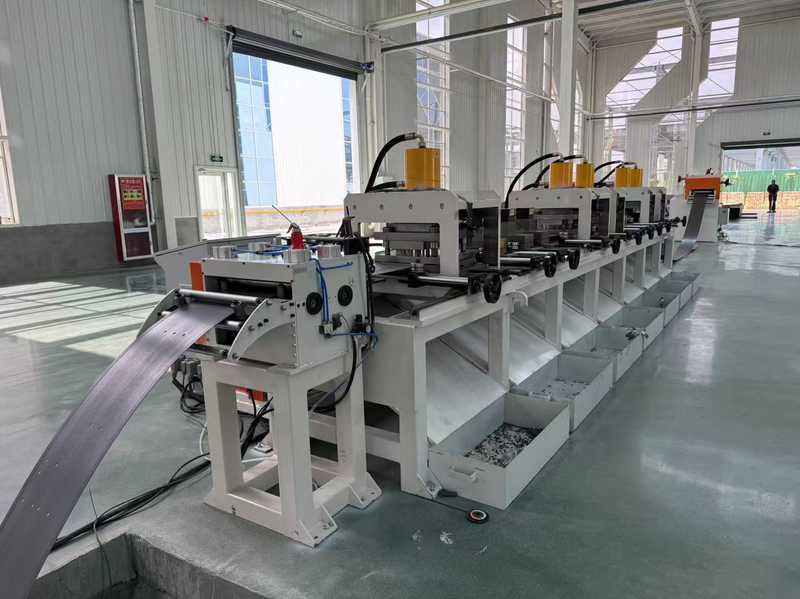
In the field of modern construction and industry, steel structures are becoming more and more widely used due to their advantages such as high strength, light weight, and convenient construction. As a key component of steel structures, Z-shaped steel plays an important role in various buildings and projects. As a special equipment for the production of Z-beams, Z-beam equipment plays a decisive role in ensuring the efficient and high-quality production of Z-beams.
The working principle of Z-shaped steel equipment is based on cold forming technology. The raw material (usually steel strip or steel coil) is unfolded by the uncoiler and then enters the leveling machine, leveling the uneven plate and laying the foundation for subsequent precise forming. Next, the plate enters the forming mainframe, which consists of a series of forming dies arranged in a specific order, and as the plate progresses gradually between the molds, the mold continuously bends and shapes the plate, so that it gradually forms a Z-shaped cross-sectional shape. During the molding process, according to production needs, punching devices can be installed at specific positions, and holes of various specifications and shapes can be punched out on the Z-beam to meet the installation and use requirements of different projects. After completing the forming and punching process, the continuous Z-beam is cut off according to the preset length through the cutting device to obtain the finished Z-beam that meets the dimensional requirements.
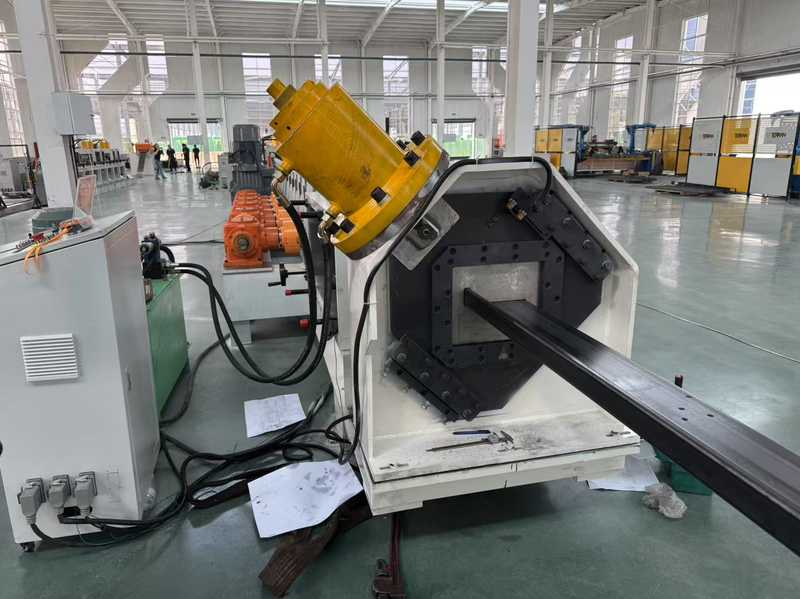
Structural composition of Z-shaped steel equipment:
1.Discharge system:
It is mainly composed of a discharge frame and an uncoiler. The unwinding rack is used to carry the raw material coils, while the uncoiler is responsible for smoothly unfolding the coils to ensure that the raw materials can enter the subsequent processing process continuously and smoothly. The discharge system needs to have good stability and precise tension control functions to ensure that the raw materials do not deviate, slack or overstretch during the uncoiling process.
2.Leveling device:
The leveling machine is the core equipment of the device, which repeatedly rolls and corrects the plate through multiple sets of staggered leveling rollers. The number, diameter and arrangement of the leveling rollers are reasonably designed according to the processing capacity of the equipment and the material and thickness of the plate. By adjusting the clearance and pressure between the leveling rollers, it can effectively eliminate the wavy shape, bending and other defects of the plate, so that the plate can achieve high-precision flatness and meet the process requirements of Z-shaped steel forming.
3.Forming Host:
This is a key part of Z-beam equipment, and its structural design and mold accuracy directly determine the forming quality of Z-beam. Forming mainframes typically have a modular design, consisting of multiple forming units, each containing one or more pairs of forming molds. The mold is made of high-quality alloy steel and has undergone precision machining, heat treatment, and case hardening, with high hardness, high strength, and good wear resistance, and can withstand tremendous pressure and friction during the molding process, ensuring long-term and stable production of high-precision Z-shaped steel products.
4.Punching system:
Depending on the production process, the punching system can be divided into two methods: online punching and offline punching. In-line punching is synchronized during the Z-shaped steel forming process, which can effectively improve production efficiency and ensure that the hole position is accurately matched with the Z-shaped steel forming size. Offline punching is the Z-shaped steel is formed and cut off, and then punching is carried out, which is suitable for some special products with complex hole shapes and extremely high requirements for hole position accuracy. The punching system is mainly composed of a punching die, a punch machine, and a positioning device, which is capable of punching holes of various shapes, sizes, and positions on Z-beams by precisely controlling the pressure, stroke, and accuracy of the positioning device.
5.Cut-off device:
The part-off device is used to cut continuously formed Z-shaped steel to a preset length. There are two common cutting methods: flying saw cutting and hydraulic cutting. Flying saw cutting is the use of high-speed rotating saw blades to cut Z-shaped steel in motion, which has the advantages of fast cutting speed and flat incision, and is suitable for occasions with high production speed. Hydraulic shearing is to drive the scissors through the hydraulic system to shear the Z-beam, which has the characteristics of large shear force, simple equipment structure, and convenient maintenance, and is suitable for cutting thicker plates. The parting device needs to be equipped with a precise length measurement and control system to ensure that the length error of the Z-beam after cutting is controlled to a minimum.
6.Control System:
Modern Z-beam equipment is equipped with advanced automated control systems, usually with programmable logic controllers (PLCs) as the core, combined with human-machine interfaces (HMIs) to achieve comprehensive monitoring and precise control of equipment operations. Operators can input product specifications, production parameters and other information through the HMI, and the PLC automatically controls the actions of each component according to the preset program to realize the automatic operation of the equipment. The control system also has functions such as fault diagnosis, alarm prompts, and production data statistics, which can monitor the operating status of equipment in real time, detect and solve faults in a timely manner, and improve the production efficiency and reliability of equipment.
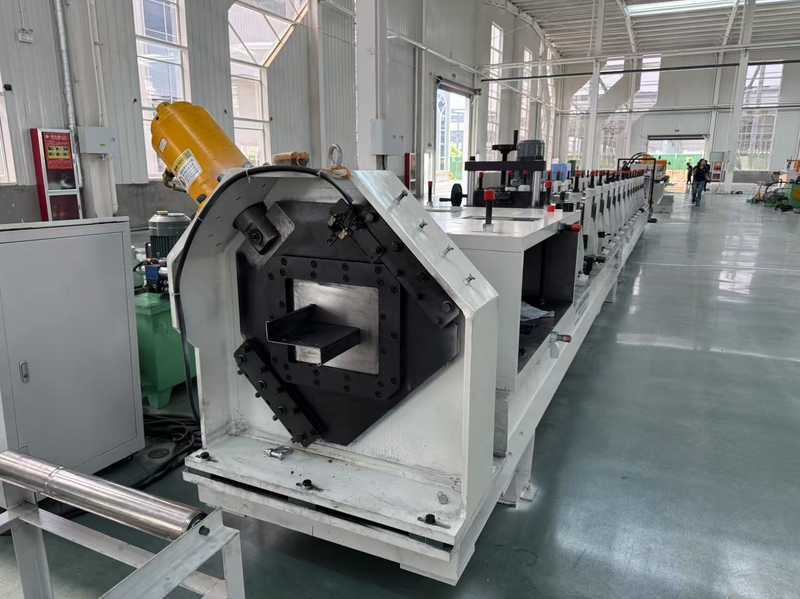
Application fields of Z-shaped steel equipment:
1.Construction industry:
In large steel buildings such as industrial plants, warehouses, gymnasiums, and exhibition halls, Z-beams are often used as roof purlins, wall purlins, and support structures. Its excellent mechanical properties and reasonable cross-sectional shape can effectively withstand the load of roofs and walls, ensuring the stability and safety of building structures. In civil residential buildings, Z-beams are also gradually applied, such as floor beams and roof beams in light steel keel structure systems, providing a lightweight, high-strength and environmentally friendly structural solution for residential buildings.
2.Transportation:
In the construction of highway and railway bridges, Z-beams can be used to make auxiliary structures of bridges, such as the support frame of bridge decks, the columns of anti-collision railings, etc. In airport construction, Z-beams can be used to construct large steel structure facilities such as hangars and terminals, meeting the requirements of transportation infrastructure for structural strength and construction speed.
3.Warehousing and logistics industry:
Various types of warehousing shelves are one of the important application scenarios of Z-beams. With its good load-bearing capacity and flexible combination, Z-shaped steel can be built into storage shelves of different specifications and forms to meet the needs of cargo storage and handling, improve the utilization of storage space and logistics operation efficiency.
Agricultural facilities: In the construction of agricultural facilities such as agricultural greenhouses and breeding houses, Z-shaped steel, as the main structural support material, has the advantages of easy installation, low cost, and corrosion resistance, and can provide a stable spatial environment for crop growth and livestock and poultry breeding.
Advantages and characteristics of Z-shaped steel equipment:
1.Efficient production:
high degree of automation, from raw material feeding, leveling, forming, punching to cutting, the entire production process can achieve continuous automated operation, greatly improving production efficiency. Some advanced Z-beam equipment can produce speeds of up to tens of meters per minute, capable of meeting the demands of large-scale production.
2.High-precision products:
The forming mold and control system of the equipment have high precision, which can ensure that the Z-shaped steel produced has high dimensional accuracy and good shape consistency. For example, the cross-sectional size deviation of Z-beams can be controlled within a very small range, meeting the strict quality requirements of Z-beams in various projects.
3.High material utilization:
By optimizing the molding process and mold design, Z-beam equipment can minimize raw material waste and improve material utilization during the production process. Compared with traditional processing methods, it can effectively reduce production costs.
4.Product diversification:
By simply replacing part of the mold and adjusting equipment parameters, Z-beams of different specifications, models, and hole shapes can be produced to meet the diverse needs of the market. This flexibility allows businesses to respond quickly to customer orders and improve market competitiveness.
5.Good equipment stability:
Using high-quality steel and advanced manufacturing technology, the overall structure of the equipment is strong and durable, and the key components have undergone strict quality testing and debugging to ensure stable and reliable performance under long-term high-intensity operation, reduce the number of equipment failures and repairs, and reduce equipment maintenance costs.